Should I DIY My Wedding Flowers or Hire a Professional Florist? What Most Couples Don’t Realize
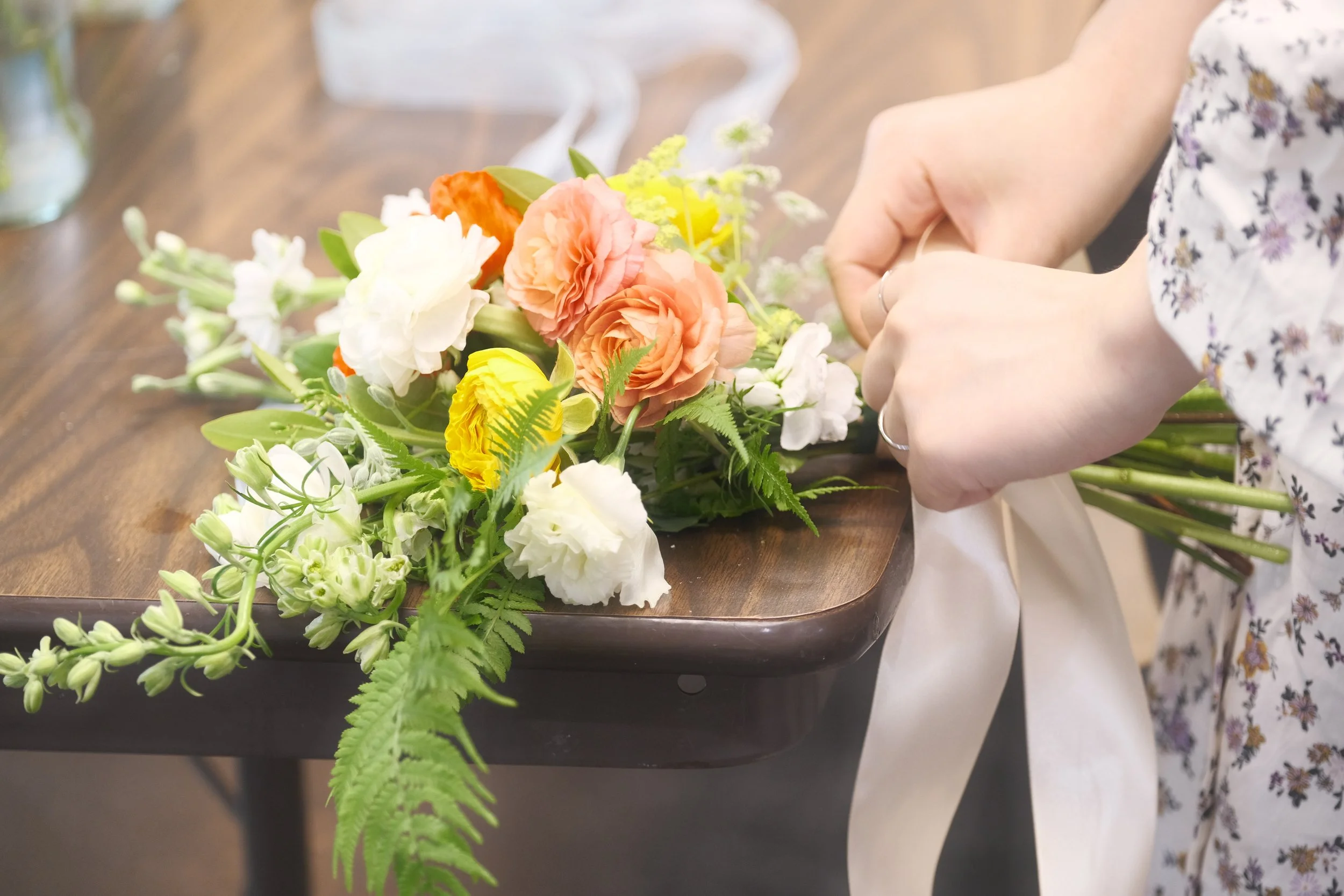
DIY wedding flowers sound like a fun idea, especially for budget-conscious couples. And who doesn’t like to play with flowers?
But what many couples don’t realize is the floral knowledge, design skill, workload, time, and logistics required to bring everything together smoothly.
What looks simple on Pinterest often involves flower sourcing, conditioning, recipe planning, designing, transportation, setup, and troubleshooting—all in the final days before the wedding.
I often like to use the analogy of a home cook versus a professional chef.
Cooking dinner for a family of four is very different from a chef catering for a hundred people. In the same way, making one simple bouquet is very different from making one bridal bouquet, six bridesmaid bouquets, nine boutonnieres, three corsages, fifteen centerpieces, an arch installation—and a few more things on top of that.
Wedding Floral Design Takes Skill
Going back to the cooking analogy, an average person can definitely cook something good. But there is a difference between a home cook and a trained chef who specializes in culinary arts.
I’m not saying I’m the five-star Michelin chef of the flower world, but my training with flowers have taught me how to create designs that feel balanced in color, texture, shape, proportion, and movement.
Wedding floral design is not simply putting pretty flowers together. A professional florist is thinking about how everything relates—from the bridal bouquet to the ceremony flowers to the reception—and how the overall design works with the venue, season, color palette, and feeling of the wedding.
Flower Knowledge and Sourcing Matter
While Trader Joe’s can offer flowers at an affordable price, professional florists have access to a much wider selection of specialty flowers that you will not normally find in a grocery store.
Florists may source flowers from wholesalers that bring in flowers from around the world, local flower farms, and in my case, from my own garden too!
Years of being both a florist and gardener have also given me a knowledge base of hundreds of different flowers and varieties. I understand when different flowers are in season, how they behave, and what role each flower can play within a design.
Flowers Are Perishable
Flowers are perishable, and they need proper handling.
Different flowers require different conditioning and care. Some are more prone to wilting than others. Some tolerate heat well, while others do not. Some need time to open before the wedding, while others may become too open if they are purchased too early.
Wedding flowers are also very much about timing.
Flowers need to arrive at the right stage, be processed and conditioned properly, designed at the right time, and stored correctly before the wedding day.
A beautiful bouquet does not help very much if the flowers are already struggling by the time the ceremony begins.
The Workload of DIY Wedding Flowers
As professional florists, we don’t really “play” with flowers. We work with flowers—often processing hundreds, if not thousands, of stems at a time.
Think of it as a chef washing, peeling, and chopping a hundred potatoes in order to serve a large crowd.
Before the designing even begins, flowers need to be unpacked, cleaned, trimmed, conditioned, sorted, and stored. Floristry is an art, but it is also a craft that needs to be executed with precision and speed.
I have seen people underestimate the workload and end up working very late the night before a wedding trying to finish bouquets and arrangements.
A wedding itself is already a highly emotional experience that requires a lot of planning. The last thing a bride wants to be doing is tying bouquets until the very last minute while worrying about whether the flowers will hold up through the celebration.
Transportation, Setup, and Wedding-Day Logistics
Transportation and logistics are another part of wedding flowers that people often forget about.
For a typical wedding, filling an entire van or truck with flowers, arrangements, buckets, tools, mechanics, ladders, vessels, and installation supplies is very common.
Then there is loading, driving, unloading, carrying flowers into the venue, setting everything up, installing ceremony flowers, styling reception tables, and sometimes returning later to move or remove installations.
Large floral installations may also need to be constructed on-site.
All of this takes time and requires experience to do efficiently.
Being able to do something is one thing. Being able to do it well is another. Being able to do it artfully under time pressure is something else entirely.
That is where professional experience really matters—whether you are a chef or a florist.
So, Should You DIY Your Wedding Flowers?
DIY flowers can absolutely work in certain situations.
If you have realistic expectations, only need some simple arrangements, and have friends or family who genuinely want to help, DIY may be something you enjoy.
But I actually think a better place for DIY flowers is a bridal shower.
A bridal shower is usually a more intimate event with fewer moving parts than a wedding. The bride-to-be and friends can gather together, arrange flowers leisurely, chat, and actually enjoy the process without the same time pressure.
A wedding day is different.
Catering, photography, music, rentals, florals, family, the wedding party, and venue logistics are all happening at the same time. Adding flower production and installation into the final day or two can quickly become another job rather than an enjoyable activity.
The question is not simply “Can I DIY my wedding flowers?”
The better questions may be:
“Is this how I want to spend the final days leading up to my wedding?”
And perhaps just as importantly:
“How do I want my wedding flowers to look?”
Hiring a professional florist is about working with someone who has an artistic eye and can bring your vision to life—sometimes in ways you may not have imagined.
It also means having peace of mind, knowing that someone experienced is sourcing the flowers, caring for them, designing them, transporting them, installing them, and troubleshooting anything that happens—so you can be fully present for your wedding day.
At Bluestone Botanique, I specialize in seasonal, garden-inspired floral design. If you decide to hire a wedding florist in New England, I’d love to help! Take a look at my wedding floral design services to learn more.